Biblical forgiveness scriptures can look clear on the page and still feel impossible when the wound has a name. What trips people up is thinking forgiveness means pretending the sin was small or that trust should snap back.
What matters is knowing what God actually asks of you, and what He does not. When anger keeps leaking into prayer, sleep, or recovery work, vague church talk will not carry you.
Start here:
- Release the debt to God without calling evil good.
- Separate forgiveness from trust, access, and reconciliation.
- Use specific verses when the hurt flares up again, so you can move cleanly.
What Forgiveness Means in the Bible
If you want to understand biblical forgiveness scriptures, start here. Most confusion comes from treating forgiveness like a mood, a personality trait, or a vague act of niceness. In Scripture, it is much more concrete than that.
Biblical forgiveness means releasing the offender’s debt to God instead of keeping your own running account of revenge, resentment, and payback. That ledger can be emotional, mental, or spiritual. You may never say a word out loud, but inside you’re still collecting. Still charging interest. Still waiting for the day they feel what they did.
That is not a small thing.
In the Bible, God’s forgiveness of sinners and our forgiveness of others are related, but they are not identical. God pardons guilt before Him. He has the authority to do that. We do not. Our role is different. We release personal vengeance and yield final judgment to Him.
One major Old Testament word for forgiveness is used 47 times, and it is used of God pardoning people, not people pardoning each other. That matters. Forgiveness begins with God’s character, not ours. We don’t invent it. We receive it from Him, then practice it under His rule.
The sacrificial system makes another point plain. In those passages, forgiveness follows atonement. Mercy is never casual. Sin is never treated as small. The Bible does not say, “Just move on, it’s fine.” It says sin is serious enough to require costly dealing.
The New Testament uses pictures like debt, redemption, and remission. Those are not soft words.
- Debt shows that something real is owed.
- Redemption shows that release comes at a price.
- Remission carries the idea of sending away, canceling, dismissing the claim.
So if someone asks, what is forgiveness in the bible, a plain answer is this: it is the obedient release of a real moral debt into God’s hands.
And here is the part many believers need to hear twice. Forgiveness is first an act of obedience and trust, not merely a feeling of emotional relief. Relief may come slowly. Sometimes very slowly. A person can make a real decision before God and still have a shaking voice by the second afternoon. Healing often unfolds after the decision, not before it.
Forgiveness is not pretending the debt never existed. It is refusing to be its collector.
Why Forgiveness Feels So Hard When the Wound Is Real
This is where many Christians get stuck. Not because they don’t know a verse, but because the wound is real and the command feels dangerous.
Forgiving can feel like saying the betrayal, abuse, rejection, manipulation, or injustice did not matter. It can feel like surrendering the last proof that you were wronged. A lot of people never say that out loud in church settings, but they feel it every time forgiveness is mentioned.
The quiet questions are usually these:
- Do I have to feel peace first?
- Does forgiveness erase consequences?
- Am I failing if I still hurt?
- If I let go, who protects the truth?
Scripture does not soften evil. It remembers grievous sins truthfully. Adultery is still adultery. Betrayal is still betrayal. Violence is still violence. The Bible never requires false positivity. It never asks you to rename darkness so you can sound spiritual.
Unforgiveness can also feel protective. It seems to preserve dignity, control, and moral clarity. We’ve seen this often in recovery work and in hard family situations. People think, “If I stop holding this, I’ll lose my footing.” But the thing that feels like armor often becomes a chain. You stay tied to the offense, tied to the offender, tied to the moment.
So forgiveness must be reframed rightly. It is not denial. It is transfer. You are taking the case out of your hands and placing it into God’s hands.
That helps separate two things that often get confused:
- Pain being processed
- Bitterness being cherished
Pain says, “This hurt, and I’m still bringing it to God.” Bitterness says, “I will keep this alive because I still want ownership of the debt.” The first can heal. The second hardens.
Biblical Forgiveness Scriptures That Reveal God’s Mercy and Christ’s Authority
Before we can handle scriptures on forgiving others, we need to look straight at how God forgives us. Otherwise forgiveness sounds like religious pressure instead of gospel truth.
Luke 5:24 is foundational. Jesus says the Son of man has authority on earth to forgive sins, and then He heals the paralyzed man. The healing confirms the claim. Christ’s mission is not just moral instruction. He has divine authority to deal with sin itself.
Colossians 1:14 brings it into the believer’s life: in Christ we have redemption and forgiveness. Not self-repair. Not spiritual debt management. Redemption means somebody else paid the cost of release.
2 Chronicles 6:21 gives us a needed posture. Solomon asks God to hear from heaven and forgive. That keeps forgiveness from becoming a theory. In Scripture, people do not stand over forgiveness as analysts. They bow under it as needy people.
Then there is Psalm 51. No polished language. No excuse-making. David speaks after catastrophic sin with confession, mercy, cleansing, and a cry for a renewed heart. It is one of the clearest places in the Bible showing that divine forgiveness is holy, personal, and transforming.
These passages hold together around a few stubborn truths:
- God hears.
- God forgives.
- God cleanses.
- God restores.
- Jesus has authority no human effort can imitate.
That last point matters. Divine forgiveness is not sentimental. It is costly and clean. It does not flatter the sinner. It remakes him.
Scriptures on Forgiving Others in Jesus’ Teaching
Jesus does not treat forgiveness as a side issue. It sits close to prayer, worship, and life in the Kingdom of God.
In Matthew 6:12, 14, and 15, Jesus teaches believers to ask for mercy while also releasing the debts of others. The debt image is important. Forgiveness does not pretend nothing is owed. It means you choose not to pursue personal repayment.
Mark 11:25 and 26 places forgiveness inside prayer. If you stand praying while gripping a grudge, something is out of order. Active communion with God and active grudge-holding do not fit together. A person can still be wounded and honest before God. But a heart that insists on keeping the private jail key has drifted far.
Matthew 18:21 to 35 presses even harder. Peter asks about limits. Jesus answers with the parable of the unforgiving servant. The master cancels a massive debt. That servant then seizes another man over a far smaller debt and refuses mercy.
The point is not that human wounds are trivial. Some are terrible. Jesus is not minimizing them. He is magnifying something else: the mercy of God toward us is immeasurably greater than the offenses we are tempted to hold forever.
Then comes Matthew 18:35, and Jesus says forgiveness must be from the heart. That cuts through religious performance. Some people say the right words while inwardly rehearsing the case every night. Jesus is not asking for polished language with untouched hostility underneath.
This is kingdom discipleship. Not optional character polishing. A forgiven people must become a forgiving people.
How to Read the Warning Verses About Unforgiveness
The warning passages are severe because Jesus is exposing the seriousness of an unforgiving heart. He is not coaching wounded people to deny trauma. That distinction matters more than many realize.
There is a difference between a believer who is struggling to obey and a believer who flatly refuses to release the debt at all. One is in the fight. The other is defending the prison.
These verses confront hypocrisy. A person cannot keep asking God for mercy while insisting on permanent private vengeance against others. That contradiction is exactly what Jesus brings into the light.
Still, recurring memories do not automatically prove you never forgave. Many believers must renew the release as pain resurfaces. That is not fake forgiveness. It is often how real forgiveness works in lived experience.
You may cry and obey at the same time. You may still feel grief after making a clean decision before God. Honest tears, confusion, and obedience can coexist. We’ve watched people think they were disqualified because peace did not arrive in one moment. That is usually not the issue. The issue is whether the heart is surrendering or clutching.
Slow healing is not the same as stubborn rebellion.
Read the warnings as an invitation to surrender, not a sentence of despair. They are meant to drive you toward Christ with open hands.
What Biblical Forgiveness Is Not
This section needs to be plain because many people are carrying bad teaching.
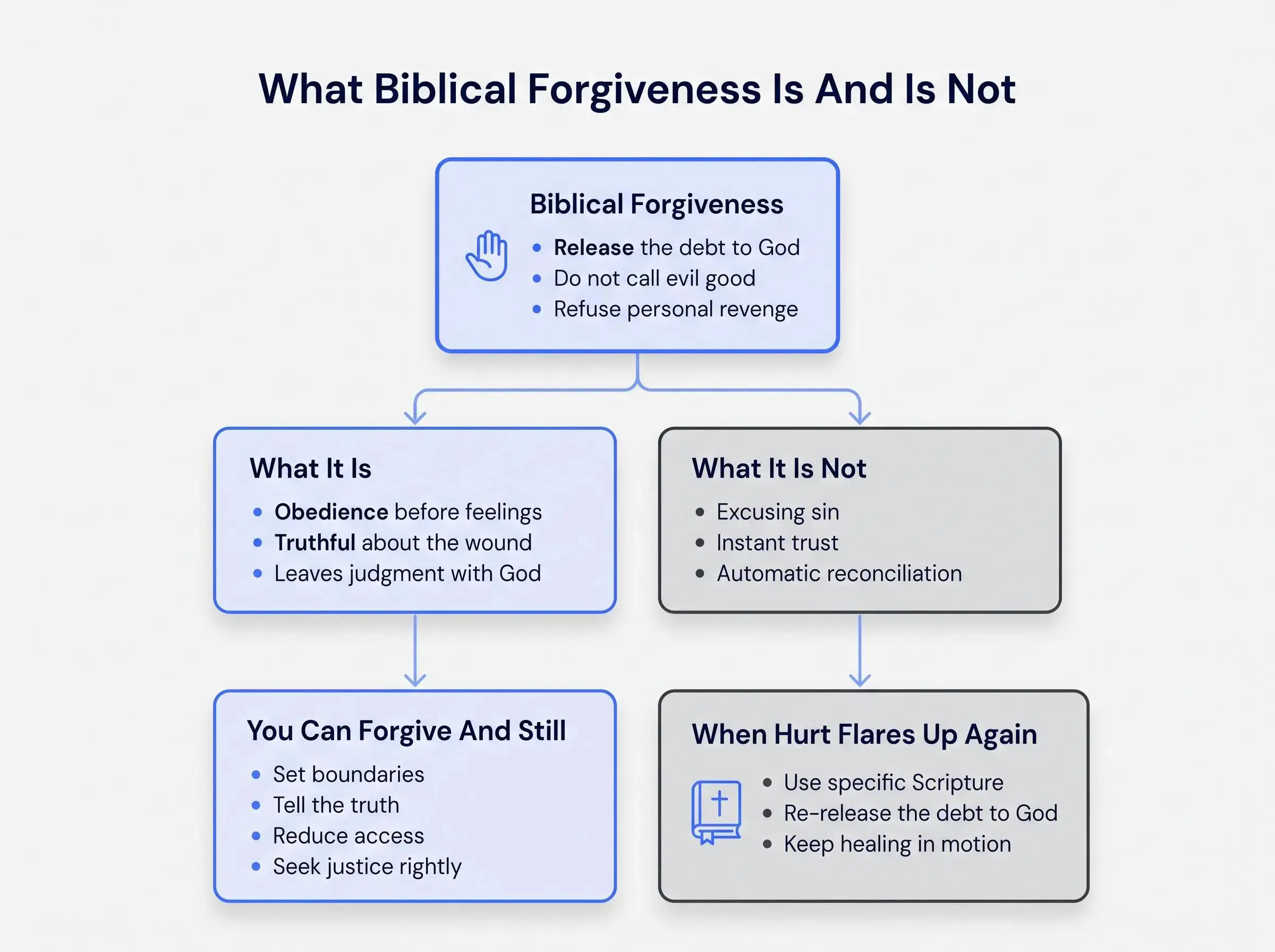
Biblical forgiveness is not any of the following:
- Calling evil good
- Pretending the damage was minor
- Forgetting every detail
- Erasing wisdom gained through suffering
- Instant trust
- Automatic reconciliation
- Removal of consequences, restitution, discipline, or legal accountability
- Passivity in the face of abuse, danger, manipulation, or repeated harm
- Emotional numbness
- A way of avoiding truth
In Scripture, forgiveness and truth-telling belong together. You can forgive and still say, “What happened was wrong.” You can forgive and still testify honestly. You can forgive and still lock a door, report a crime, or decline renewed access.
A lot of damage gets done when Christians use forgiveness language to pressure people back into unsafe situations. We should say that plainly. That is not biblical mercy. That is confusion wearing religious clothes.
When Forgiveness, Trust, and Reconciliation Are Different
These three get blended together all the time, and when they do, people either harden or get hurt again.
Forgiveness releases vengeance. Trust is earned over time. Reconciliation is the rebuilding of relationship. They are connected, but they are not the same thing.
Reconciliation may be limited, delayed, or impossible when the offender is unsafe, deceptive, absent, dead, or unrepentant. That doesn’t cancel forgiveness. It just means relationship requires more than one willing heart and more than one emotional moment.
A believer can forgive and still:
- Set firm boundaries
- Reduce access
- Tell the truth
- Involve proper authorities
- Refuse private retaliation
Think of the cases many readers are actually carrying. An unfaithful spouse. An abusive parent. A manipulative leader. A violent offender. A friend who never apologized. In these situations, leaving justice with God does not forbid earthly justice. It forbids personal revenge.
Many wounded Christians feel shame here. They assume boundaries prove a lack of forgiveness. Often the opposite is true. Wise boundaries may be one of the clearest ways to honor truth.
Forgiveness changes the posture of the heart. Reconciliation depends on repentance, honesty, safety, and time.
A Bible-Based Forgiveness Prayer for Real Hurt
A good forgiveness prayer bible pattern should help you act, not just admire theology. Keep it simple. Keep it truthful.
Use a prayer like this as a framework:
Guided prayer sequence
- Be honest
Tell God honestly what happened.
- Name emotions
Name the fear, anger, humiliation, and desire to strike back.
- Confess bitterness
Ask Him to hear and forgive you where bitterness has grown.
- Identify the offense
Name the person and the offense specifically.
- Release the debt
Release that debt to God in plain words.
- Ask for cleansing
Ask for cleansing, inner clarity, and wisdom for next steps.
- Keep releasing
Ask for grace to keep releasing it when memories return.
You might pray in language like this:
Lord, You see what happened. You know the wound, the anger, and what it has done in me. I confess the bitterness that has grown around it. I release this person and this debt to You. Cleanse me, guide me, and show me what obedience looks like next.
Don’t stay vague and religious. Name the offense. That is often where the real work begins. This kind of prayer is especially useful in recovery ministry, prison ministry, family estrangement, and long-term grief, where the same wound can reopen many times.
A Practical Way to Forgive When You Still Feel Angry
Here is the street-level process. Not polished. Just workable.
First, tell the truth about what happened. Don’t shrink it. Don’t dramatize it. Don’t spiritualize it away.
Second, identify what the offense is producing in you now. It may be rage, obsessive replaying, withdrawal, numbness, fantasies of payback, or self-destructive behavior. If you don’t name the fruit, you’ll keep calling it “just stress.”
Third, bring the offense to Christ and make a clear decision before God to release personal vengeance. Say it plainly.
Fourth, repeat that decision whenever the memory reopens the wound. Real forgiveness often has to be reaffirmed before it feels settled. This surprises people. It shouldn’t.
Fifth, decide whether any outward action is needed. That might involve confession, conversation, accountability, boundaries, distance, or reporting wrongdoing. Sometimes obedience is quiet prayer. Sometimes it includes hard action by Tuesday morning.
Sixth, look for fruit. Not instant calm, but signs like these:
- less obsession
- less desire to injure back
- more freedom in prayer
- more readiness to obey God
- less inward argument with the past
Measure progress by growing freedom from bitterness, not by instant emotional ease.
If you need a more guided companion, Terry Stueck’s Forgive Instantly & Live Free is especially useful when unforgiveness is tangled up with anger, stress, hang-ups, or addictions. It stays practical, which matters when the issue is not theory but bondage.
How Forgiveness Helps Christians in Recovery and Spiritual Healing

This is where the issue gets painfully real. Buried resentment often fuels anger, isolation, spiritual confusion, and destructive coping patterns. A person may try to change habits while the old injury is still governing reactions underneath.
We’ve seen people work hard on behavior while ignoring the grievance engine driving it. That usually doesn’t hold. Sooner or later the hurt starts talking again, and the old pattern follows.
Biblical forgiveness can break the ongoing link between an old offense and a present cycle of rage, despair, or self-sabotage. Not because forgiveness solves every trauma or addiction issue by itself. It doesn’t. We should be honest about that. But it can remove a deep root of bitterness that keeps many people stuck.
That fits the kind of first-century Christianity we care about at High Plains Bible Mission. Not religion as clean language for messy people. Real allegiance to Christ where people actually live, fail, grieve, and recover.
Forgiveness is not weakness for damaged people. It is courage, surrender, and spiritual clarity for wounded people who want freedom.
Take the both-and path:
- pray honestly
- repent where needed
- set wise boundaries
- seek help when needed
- keep healing in motion
One shallow religious gesture won’t do the job. But a truthful, repeated surrender to Christ changes people.
Conclusion
The core message of these biblical forgiveness scriptures is clear. God has authority to forgive. Christ’s redeeming work is the basis of pardon. And Jesus plainly calls believers to forgive others from the heart.
That does not mean excusing evil, erasing truth, or offering unsafe trust. It means releasing the debt and leaving justice with God. That is the distinction many hurting Christians need most.
Choose one passage from this article today. Pray it honestly. Then name the debt you need to release before God. Start there. Not with polished feelings. With truth, surrender, and obedience.
Pingback: Does the Bible Really Teach Us to Forgive and Forget?
Pingback: How to Find Self-Forgiveness in the Bible as a Christian
Pingback: How to Forgive Someone Who Hurt You According to the Bible
Pingback: How to Know If You Have Truly Forgiven Someone