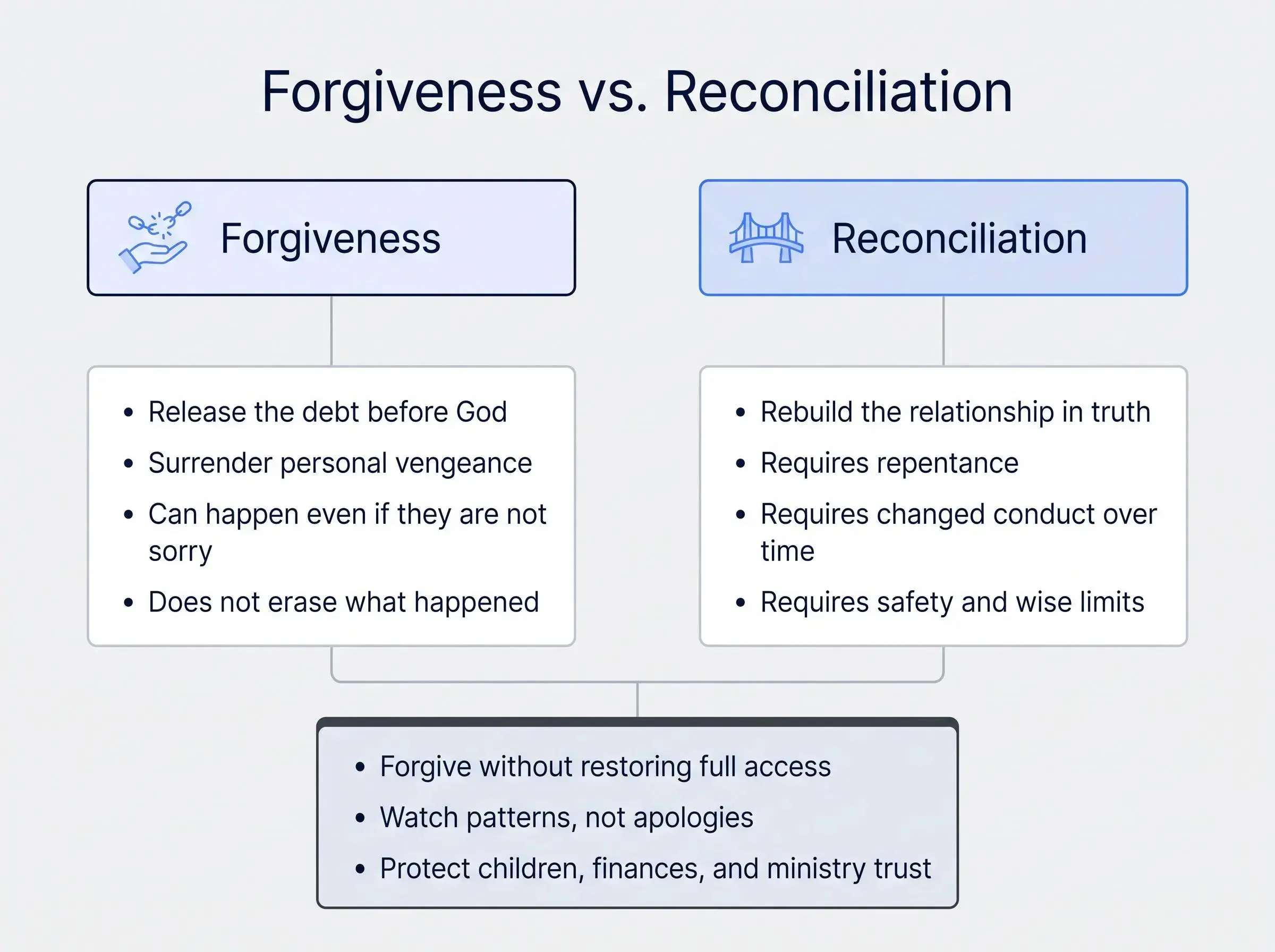
Forgiveness versus reconciliation gets confused when someone tells you to “move on” after betrayal, abuse, relapse, or church hurt. You can release vengeance to God without handing back the keys to your life.
What matters is truth: forgiveness is your obedience before God; reconciliation requires repentance, change, and safety. Don’t let spiritual pressure make you ignore a repeating pattern.
Keep these lines clear:
- Forgive the debt without restoring private access.
- Watch for changed conduct, not tearful apologies.
- Protect children, finances, and ministry trust while healing.
Walk free without walking back into harm.
Why This Question Feels So Heavy for Wounded Christians
A lot of believers come to this question with a knot in their stomach. They aren’t asking for a definition. They’re asking, “If I forgive, do I have to let this person back in?” That is a very different problem.
For some people, this is about repeated betrayal in marriage or family. For others, it’s church hurt, manipulation, addiction-fueled destruction, abuse, or criminal wrongdoing. The details change, but the pressure feels similar. You’re trying to obey Jesus without pretending the wound didn’t matter.
Many readers carry false guilt here. They fear disobeying Christ if they don’t reopen the relationship fast enough. People around them may say, “Just move on,” when the damage is still fresh, the pattern is still active, or the person who caused harm is still lying. That kind of pressure can leave you feeling trapped between grace and safety.
We want to say this plainly: faithful Christianity does not ask people to call evil good. It does not ask you to step back into harm to prove you’re spiritual.
Here’s the central distinction. Forgiveness is a heart-level release before God. Reconciliation is a relational rebuilding that requires truth, repentance, and wise limits. If you miss that difference, everything gets muddy.
What Forgiveness Means in a Christian Sense
In the Christian sense, forgiveness means releasing the personal debt of the offense before God. It means you stop carrying the case as judge, jury, and executioner in your own heart.
That does not mean the offense was small. It doesn’t mean you’re saying, “It was fine.” It means you’re giving up bitterness, revenge, and private vengeance. Forgiven people are called to forgive. We don’t get to hold onto resentment as if it were a rightful possession.
A hard truth sits here. Forgiveness is something the offended person does before God, even if the offender never apologizes. That matters because some people wait years for the other person to become honest, soft, or sorry. Meanwhile the wound keeps running their inner life.
Forgiveness often includes things like these:
- naming the sin honestly instead of minimizing it
- repenting of sinful anger where your own heart has gone dark
- surrendering the urge to punish personally
- refusing to let the offense keep ruling your thoughts, reactions, and prayers
It also helps to be realistic. Forgiveness can be a decisive act, and it may still need reaffirming. Memories come back. The body remembers. Anger flares again on an ordinary Tuesday afternoon. That doesn’t always mean you failed. Sometimes it means you need to release the debt again, specifically and before God.
If you’re asking how to forgive someone who is not sorry, this is where it begins. Not with their apology. With your obedience.
Forgiveness releases the debt. It does not rewrite the history.
What Reconciliation Means and Why It Is Different
Reconciliation is the restoration of a broken relationship. Unlike forgiveness, it cannot be completed by one person alone.
That’s where many Christians get tangled. Forgiveness is something you can do before God today. Reconciliation is mutual. It involves the other person telling the truth, owning the wrong, turning from it, and showing change over time. Words matter, but words are cheap when they keep arriving attached to the same behavior.
Reconciliation is more than an apology
A biblical reconciliation process includes more than “I’m sorry.” It usually involves:
- acknowledgment of the wrong in specific terms
- repentance, not vague regret
- changed conduct that can actually be observed
- trust rebuilt gradually, not demanded instantly
And we need another distinction here. Restored fellowship is not always the same as restored closeness, access, or former roles. In Christian community, you may receive someone as a brother or sister in Christ without giving them the same influence, private access, leadership responsibility, or emotional closeness they once had.
That isn’t cold. It’s honest.
Some relationships can heal deeply. Others remain limited. That’s not a failure of grace. Sometimes it’s the fruit of wisdom.
Forgiveness Versus Reconciliation in One Clear Comparison
Let’s answer forgiveness versus reconciliation directly. They are related, but they are not the same act.
Here is the cleanest way to see it:
- Forgiveness takes one willing heart before God.
- Reconciliation takes two willing people walking in truth.
- Forgiveness deals with debt and bitterness.
- Reconciliation deals with the future of the relationship.
- Forgiveness can be offered immediately.
- Reconciliation usually takes time, evidence, and safety.
- Forgiveness is commanded regardless of the offender’s response.
- Reconciliation depends in part on the offender’s repentance and conduct.
This is where the question does forgiveness mean reconciliation gets answered plainly. No, not in every case.
Forgiveness does not automatically restore trust, access, partnership, or intimacy. Reconciliation should never be confused with excusing sin, enabling repeated harm, forgetting what happened, or returning to business as usual because everyone feels awkward.
A lot of damage gets done when people rush past this point. They call it peace, but it’s usually denial wearing church clothes.
What Biblical Forgiveness Is Not
We need to clear away the fog. Christians often use the word forgiveness to cover things Scripture does not ask of us.
Biblical forgiveness is not:
- approval of sinful or criminal behavior
- canceling earthly consequences for serious wrongdoing
- stopping church discipline when discipline is needed
- refusing to report abuse, exploitation, or illegal conduct
- instant emotional healing
- instant trust
- immediate closeness
- passivity in the face of repeated harm
- abandonment of wisdom, boundaries, or protection for vulnerable people
A Christian may forgive personally while still pursuing justice, accountability, or protection for others. Those are not enemies. In many cases, refusing to act is the unloving response.
This matters a great deal in church life, recovery settings, family systems, and prison ministry. Some people know how to say spiritual words while still avoiding truth. Forgiveness is not a tool for keeping victims quiet.
Does Forgiveness Mean Reconciliation
No. Forgiveness does not always mean reconciliation.
The confusion happens because many believers have heard “forgive and forget” preached as if it automatically means restored relationship. But heart release and relationship restoration are different things. If you blend them together, wounded people end up carrying burdens Jesus never placed on them.
Reconciliation may be good and desirable. It is not always possible, safe, or wise right now. If an offender remains deceitful, abusive, manipulative, or unrepentant, the relationship cannot be repaired by the injured person alone. You cannot reconcile by yourself with someone who keeps breaking truth.
And let’s be honest about another common problem. “I’m sorry” doesn’t rebuild trust if the pattern keeps repeating. By the fifth apology, the words start sounding like a tool.
If you fear that refusing immediate reconciliation means you’re refusing to forgive, hear this clearly: saying “not yet” to restored access is not the same as saying “no” to forgiveness. Obedience to Jesus does not require you to ignore reality.
Can You Forgive Without Restoring the Relationship
Yes. A Christian can forgive without restoring the relationship.
For some readers, that sentence feels like oxygen. Especially if your story includes abuse, repeated relapse without responsibility, predatory behavior, refusal to admit harm, or danger to children and other vulnerable people.
Boundaries can be one-sided
Forgiveness can be unilateral. Reconciliation cannot. Boundaries can be put in place by one person when needed. You don’t need mutual agreement to stop handing someone the same access they used to do damage.
That may look like:
- no private access
- no financial trust
- no ministry platform
- no unsupervised contact
- no return to prior intimacy
Distance is not always bitterness. Sometimes distance is wisdom with its eyes open.
This is especially important in recovery and family trauma settings. A person may sincerely forgive someone whose addiction blew up the household, emptied accounts, lied for months, or brought danger into the home. That forgiveness is real. It still does not require handing back car keys, passwords, or unsupervised access to the children.
Some relationships never return to what they were. That hurts. But pain does not make truth less true.
The Biblical Reconciliation Process
When reconciliation is possible, it usually comes through a path of truth, repentance, and tested trust. Not instant restoration. Not sentimental pressure.
A biblical reconciliation process often looks like this:
How reconciliation typically unfolds
- Name the rupture
The rupture is named honestly. No minimizing.
- Acknowledge the sin
The offender acknowledges the sin specifically, without blame shifting.
- Turn from the behavior
The offender turns from the behavior and shows willingness to keep turning from it.
- Look for fruit
Visible fruit begins to appear, especially over time.
- Accept consequences
Necessary consequences, restitution, accountability, or protective measures are accepted.
- Rebuild contact
Communication and contact are rebuilt gradually, with clear expectations.
- Regrow trust
Trust grows in proportion to proven faithfulness.
That last line matters. Trust should grow in proportion to proof, not pressure.
Another point often gets skipped: the person who caused the grievance bears responsibility to seek repair. The wounded person is not required to force reconciliation, carry the whole process, or pretend the other party is participating when they aren’t.
Even when reconciliation becomes real, former privileges may not return. A leader may be forgiven and still remain unfit for office. A relative may be welcomed at family gatherings and still not be safe for private access. Fellowship can be restored without restoring everything.
| Step | What it looks like | Why it matters |
|---|---|---|
| 1 | The rupture is named honestly, with no minimizing. | Reconciliation starts with truth, not pressure to act like nothing happened. |
| 2 | The offender acknowledges the sin specifically, without blame shifting. | Specific ownership shows more than a vague apology. |
| 3 | The offender turns from the behavior and shows willingness to keep turning from it. | Repentance means change in direction, not regret alone. |
| 4 | Visible fruit appears over time. | Proof matters more than emotional words after deep harm. |
| 5 | Necessary consequences, restitution, accountability, or protective measures are accepted. | Forgiveness does not cancel consequences or protection. |
| 6 | Communication and contact are rebuilt gradually, with clear expectations. | Restoration is a process, not instant access. |
| 7 | Trust grows in proportion to proven faithfulness. | Trust should follow evidence, not pressure. |
How to Forgive Someone Who Is Not Sorry
This is one of the hardest parts of Christian obedience because your heart wants some kind of closure first. But if you’re waiting for a perfect apology, you may be waiting a long time.
Here’s a workable path for how to forgive someone who is not sorry.
First, get honest before God about what happened. Name the offense. Name the damage. Name what it stirred up in you, whether that’s rage, fear, shame, grief, or a desire to get even.
Then separate your forgiveness from their response. Your obedience cannot be held hostage by their hardness.
After that, release the debt specifically. Not in vague language. Say what you’re forgiving. Renounce personal vengeance, including the private fantasy of making them suffer back.
You will likely need to keep bringing recurring anger, anxiety, and grief to God. Severe wounds don’t usually go quiet because you said one prayer. Stay with it. Repeat the release when the memory bites again.
A few practical helps:
- keep wise boundaries if contact would produce more harm or confusion
- seek support from mature believers when the wound is severe or tangled
- don’t confuse lingering pain with failed forgiveness
- if needed, use a structured guide instead of trying to sort it out in your head every night
For readers who want practical help with that process, Terry Stueck’s Forgive Instantly & Live Free can be a useful next step. It is plainspoken and built for real anger, real hurt, and real release.
When Trust Should Be Rebuilt Slowly or Not Yet
Trust is earned in time and can be damaged in a moment. Most people know that instinctively, then feel guilty for acting on it.
If you’re deciding whether contact or closeness should increase, look past words. Watch the pattern. Reconciliation should be delayed when you see repeated offenses, partial confession, manipulation, pressure to move on quickly, denial of impact, refusal of accountability, or ongoing unsafe behavior.
Words alone are often useless after deep betrayal. The deeper the wound, the more proof matters.
Look for signs like these:
- consistency over time
- humility when limits are set
- teachability instead of defensiveness
- willingness to accept consequences
- truthfulness when nobody is managing the impression
A believer can stay open to future reconciliation without pretending the relationship is ready today. Those are not the same thing.
Church pressure often gets this wrong. Quick access is not the same as grace. Protecting the vulnerable is not unchristian. It is part of love and wisdom.

What the Bible’s Stories Teach About Forgiveness Without Immediate Reconciliation
Scripture gives us categories here, if we’ll slow down enough to see them.
Joseph did not instantly restore normal relationship with his brothers. He tested their change before fully revealing himself. That wasn’t cruelty. It was discernment. In ordinary life, that speaks to family wounds and repeated betrayal. You don’t ignore history just because tears show up in the room.
David showed mercy toward Saul and refused to take vengeance, yet he did not naively put himself back within Saul’s reach. That is a strong picture of personal restraint without reckless reentry into danger.
Paul and Barnabas had such sharp disagreement that their partnership did not simply snap back into place. Even among sincere believers, restored mission and restored closeness are not automatic in every conflict.
Forgiveness can be real while trust stays limited.
That applies in homes, churches, recovery work, and ministry teams. Sometimes the godly thing is mercy without denial.
Real-Life Situations Where the Difference Matters Most
This distinction becomes very practical very fast.
In marriage, family, or friendship, repeated apologies with no lasting change should push you to ask two different questions: Have I released the debt before God? Is this relationship actually safe and truthful enough to rebuild?
The same two questions help in financial dishonesty. If someone took money, lied about commitments, or broke trust in practical ways, forgiveness does not require restored financial access.
In sexual abuse or exploitation, forgiveness does not mean renewed access. It does not mean private meetings, unsupervised contact, or silence.
In church conflict, forgiving a person does not remove the need for accountability or discipline. In recovery-related damage, real repentance includes sustained change and willingness to repair what can be repaired. In prison or reentry settings, mercy and accountability both belong on the table. If either one is missing, things go crooked.
The safety question is not merely theoretical. In the U.S., the Bureau of Justice Statistics estimated 2.2 violent victimizations by a current or former intimate partner for every 1,000 people age 12 or older in 2023, down from 3.4 per 1,000 in 2022, using its nationally representative National Crime Victimization Survey. The report counts violent victimizations, not every form of coercion, betrayal, or relational harm. It also cannot decide what is safe in any one relationship. But it underscores why forgiveness should never be used to rush someone past sober assessment of danger, accountability, and access.
Common Mistakes Christians Make When They Confuse These Two Ideas
A lot of preventable harm comes from mixing these categories.
Some common mistakes are easy to spot once you know what you’re looking for:
- equating forgiveness with immediate trust
- using spiritual language to avoid grief, confrontation, or consequences
- pressuring victims to reconcile faster than wisdom allows
- treating a verbal apology as proof of repentance
- calling boundaries bitterness when they are actually responsible love
- assuming that if consequences remain, forgiveness must not be real
- confusing reconciliation with returning everything to the way it was before
- ignoring power imbalances, addiction patterns, or repeated manipulation
At root, this confusion often forgets something basic about allegiance to Jesus. Truth and mercy belong together. They do not compete. A first-century Christian understanding of discipleship has room for both open hands and clear eyes.
How a First-Century Christian Lens Brings Clarity
When forgiveness is treated as emotional performance for other people’s approval, confusion follows. A Kingdom-centered view clears that up. Forgiveness is an act of allegiance to King Jesus.
Early Christian faithfulness was not sentimental tolerance of evil. It was a transformed way of living in truth, mercy, holiness, and courage. That helps you hold two things together at once: release personal vengeance and refuse participation in lies.
That is where many people finally settle down inside. You do not have to choose between being merciful and being honest. In Christ, those belong together.
If you want to go deeper into that Kingdom framework, Terry Stueck’s The Kingdom in 1st Century Christianity and The Seeker’s Guide to the Kingdom of God can help. Both press on allegiance, citizenship, and the kind of life Jesus actually calls His people to live.
Conclusion
Forgiveness versus reconciliation is not a choice between grace and wisdom. It is a needed distinction between releasing the debt and rebuilding the relationship.
You can obey Jesus fully without denying pain, canceling consequences, or stepping back into danger. That isn’t lesser Christianity. It’s clearer Christianity.
So take one practical step. Identify the specific hurt before God. Release personal vengeance. Then assess the relationship honestly. Is there repentance? Is there truth? Is there safety enough for any level of reconciliation?
If the answer is still tangled, keep going with prayer and wise counsel. And if you need a more practical path through anger and hurt, Forgive Instantly & Live Free may help you put feet on what you already know you need to do.
Pingback: Forgive Repeated Offenses: Seventy Times Seven Meaning
Pingback: Powerful Prayer for Forgiveness and Letting Go