Christians often flatten the kingdom of God vs heaven into one idea, then miss what Jesus was pressing on: Who rules your life now? Heaven is precious, but Jesus’ call was never only about getting somewhere later.
That difference reaches anger, addiction, forgiveness, and the private places where self-rule digs in. Don’t let familiar church language blur the King’s actual claim on you.
Watch for these anchors:
- Heaven is God’s dwelling; the kingdom is His rule.
- Matthew’s “kingdom of heaven” points to God’s kingdom, not a separate one.
- Repentance means changing allegiance, not just feeling sorry.
Read Jesus’ words with your whole life on the table.
The Short Answer: Related, but Not Identical
Let’s answer the main question plainly. In the kingdom of god vs heaven discussion, we’re not choosing between two unrelated ideas, but we also shouldn’t mash them into one word every time.
Heaven is the place of God’s throne, the present heavenly order. The Kingdom of God is God’s rule, authority, and active government. Those overlap, but they are not identical.
That clears up two common questions right away:
- Is the kingdom of god the same as heaven? Not exactly.
- Is kingdom of god and kingdom of heaven the same? In the Gospels, those two phrases usually point to the same kingdom.
This matters more than people think. If you treat God’s kingdom as only a future destination, you can hear Jesus preach “repent” and somehow file it under “later.” But Jesus did not announce a message built only around where you go after death. He announced the rule of God pressing in now.
That changes the whole feel of discipleship. You’re not just waiting for transport. You’re being called under a King.
What Heaven Means in Scripture
Heaven in Scripture is not just a mood, a symbol, or a religious way of saying “everything turns out fine.” It is spoken of as the place of God’s throne and the place from which His purposes proceed.
The New Testament treats heaven as real in concrete ways:
- Jesus ascended to heaven after His resurrection.
- Jesus will return from heaven.
- Heaven is described as God’s throne.
Most believers instinctively think of heaven as the place where they go to be with the Lord. That instinct is not wrong. It would be cruel to call that hope small. For many suffering Christians, that hope has kept them standing another day.
Still, it becomes incomplete when it replaces the center of the gospel. That’s where confusion creeps in. A person can talk about heaven constantly and still miss what Jesus preached constantly.
Scripture also points beyond the present order to a new heaven and a new earth. That keeps us from shrinking redemption down to “souls leaving earth.” God is not abandoning His creation. He is bringing His purposes to completion.
So heaven is real hope. Precious hope. But it is not the full meaning of Jesus’ kingdom message. If we make it the whole story, we end up with a faith that comforts the future while leaving the present mostly untouched.
And Jesus never preached that way.
What the Kingdom of God Means in Scripture
The Kingdom of God is God’s kingly rule. Not a spot on a map. Not merely a church service. Not a code word for “religion.”
A kingdom includes at least three things:
- the authority of the king
- the exercise of that authority
- the people brought under it
That’s important because people often flatten the phrase. Some make it identical with the church. Some push it entirely into the future. Some reduce it to heaven after death. Scripture doesn’t let us do any of those things neatly.
In the Bible, God’s kingdom language works in several ways at once. God’s kingdom refers to His sovereign rule. People can enter the kingdom. People are told to seek the kingdom. Jesus announced that the kingdom had drawn near.
That last point should stop us for a minute. When Jesus came preaching, He was not mainly giving travel details about the afterlife. He was announcing that God’s reign was confronting human rebellion in the present. That’s first-century clarity, and we’ve badly needed it back.
This gets painfully practical. God’s kingdom reaches pride, anger, addiction, fear, divided loyalties, and that deep habit of self-rule we all carry. The kingdom is not abstract theology for healthy people with spare time. It is God’s claim on afflicted and hurting people who need a real King because they have made a wreck of being their own.
We’ve seen this confusion up close in recovery-minded discipleship. A person can sincerely believe in Jesus and still keep one locked room inside, one habit, one grudge, one secret loyalty. Kingdom preaching goes to that room. It knocks hard.
The kingdom is where God gets His way, starting with us.
What Kingdom of Heaven Means in Matthew
When readers ask about kingdom of heaven meaning, the first thing to say is simple: Matthew often uses “kingdom of heaven” as his usual way of speaking about God’s kingdom.
Here are the plain facts:
- “Kingdom of heaven” appears 32 times.
- It appears only in Matthew.
- “Kingdom of God” appears 68 times across 10 New Testament books.
That pattern is not random. Matthew writes in a strongly Jewish setting. In that setting, “heaven” can work as a reverent way of referring to God or to rule that comes from God. The phrase also points to the kingdom’s origin and character. This kingdom comes from heaven. It does not rise out of earthly empire, political force, or human talent.
That matters because first-century Israel knew what earthly rule felt like. Rome had power. Herod had power. Religious leaders had power. Jesus was not announcing one more version of the same thing with Bible language sprinkled on top.
Matthew’s wording fits Israel’s hopes, messianic expectation, and God’s promised rule breaking into history through Jesus. But Matthew does not act as if “kingdom of heaven” and “kingdom of God” are locked into two separate systems. He still uses “kingdom of God” at points. That alone should make us cautious about overbuilt theories.
Some readers want to dig deeper into that early Christian emphasis on the kingdom, especially in the first centuries. Terry Stueck’s The Kingdom in 1st Century Christianity is useful there because it keeps the subject tied to lived Christianity rather than leaving it in a word study.
| Phrase | Occurrences | New Testament distribution |
|---|---|---|
| Kingdom of heaven | 32 | Only in Matthew |
| Kingdom of God | 68 | Across 10 New Testament books |
Are the Kingdom of God and the Kingdom of Heaven the Same?
This is where the answer needs to be firm. If you’re asking, “is kingdom of god and kingdom of heaven the same,” the strongest biblical answer is yes, in the Gospel accounts these phrases repeatedly refer to the same reality.
The clearest example is Matthew 19:23-24. In the same conversation about the rich young ruler, Jesus first speaks of entering the kingdom of heaven and then of entering the kingdom of God. He shifts terms without signaling that He has switched subjects.
That’s not a minor detail. Jesus Himself moves between the phrases.
The same pattern shows up elsewhere:
- Matthew 4:17 and Mark 1:15 report the same kingdom announcement with different wording.
- Matthew 5:3 and Luke 6:20 give the blessing of the poor using the two different phrases.
- Matthew’s parables about the kingdom match Mark and Luke where they use “kingdom of God.”
- Matthew 8:11 and Luke 13:28-29 describe the same feast with Abraham, Isaac, and Jacob, again with different phrasing.
So no, the Gospels are not presenting two competing kingdoms, one called “of heaven” and another called “of God.” The cleaner distinction is between those kingdom phrases and heaven itself.
People sometimes inherit a sharp division here and defend it hard. We don’t need to be rude about that. But we do need to say what the text is doing. The text does not behave as if Jesus is offering two separate kingdoms depending on the audience. It behaves as if Matthew often prefers one phrase while referring to the same kingdom announced elsewhere.
How Heaven Differs From God’s Kingdom
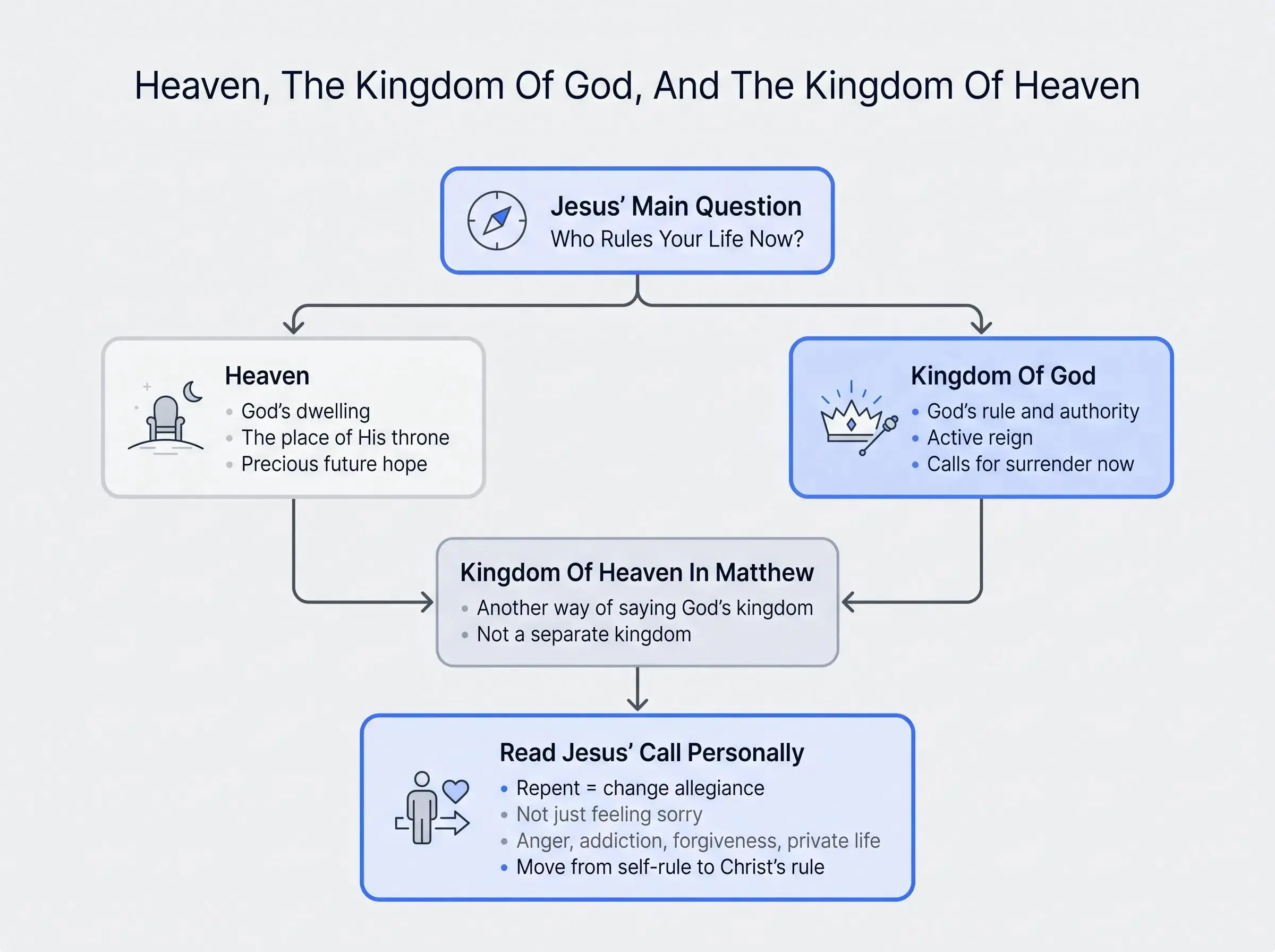
This is the point many readers have needed all along. If you’re asking, “is the kingdom of god and heaven the same thing,” the answer is no.
Heaven is the place of God’s throne. The Kingdom of God is God’s reign.
Here’s the relationship in plain terms:
- God rules from heaven.
- His kingdom comes from heaven.
- His kingdom can be present on earth wherever His rule is welcomed.
That last line changes the feel of Christian life. If heaven becomes the whole gospel, discipleship turns passive. Faith becomes waiting, coping, and trying not to fall apart until departure time. But if the kingdom is only a future location, Jesus’ present commands lose their sharp edge.
A simple teaching line helps:
Heaven is where God reigns unhindered. The kingdom is that reign extending its claim over lives, communities, and finally all creation.
Many believers were taught to think mostly about going somewhere later. Again, that hope is real. But Jesus also teaches us to pray for God’s will to be done on earth now. That prayer makes no sense if the whole point is escape.
This is where people feel the pinch. We can sing about heaven and still resist God’s authority in our speech, our money, our grudges, our habits. The issue is not whether we like kingdom language. The issue is whether we yield.
The Kingdom Is Present Now and Future Still
The New Testament holds a tension that actually helps, once you stop fighting it. Jesus announced the kingdom as near, and Scripture still points to a future fullness of God’s reign.
Both sides matter.
In the present, the King has come. People can repent, believe, obey, and begin living under His rule now. The kingdom is active now, not only someday.
In the future, Christ will return from heaven, evil will be judged, and God’s purposes will be completed in the new creation. We are not there yet, and pretending otherwise makes a mess fast.
A lot of confusion comes from swinging to one extreme:
- some reduce the kingdom to an inward spiritual feeling
- others reduce it to a future event and miss its present force
Neither will carry a suffering Christian very far. In prison ministry, recovery work, spiritual restoration, or long seasons of temptation, people need both truths. They need to know God’s kingdom is active now, or faith becomes distant. They also need future hope, or present pain starts to define the whole horizon.
By the second or third hard week, bad theology shows up in real behavior. If the kingdom is only future, people drift. If the kingdom is only present and inward, suffering can crush them when change isn’t immediate. Scripture gives a sturdier frame than either mistake.
Common Mistakes Christians Make With These Terms
This confusion usually comes from habit, not rebellion. Still, some habits need correcting.
Treating heaven as the main summary of Jesus’ preaching
Jesus certainly spoke of heaven, but His central public message was the kingdom. Read the Gospels with that in view and the whole tone shifts.Assuming kingdom of heaven meaning refers only to leaving earth for heaven
In Matthew, the phrase usually means God’s kingdom, not relocation after death. Context decides the point, not tradition alone.Inventing two separate kingdoms every time Matthew and the others use different wording
The parallel passages push against that. The Gospel writers often report the same teaching with different phrasing.Turning the kingdom into a vague religious feeling
God’s kingdom means authority, obedience, allegiance, and actual change. A feeling may accompany that. It cannot replace it.Making the whole discussion academic
If your definition never touches repentance, obedience, forgiveness, or loyalty to Christ, something has gone sideways.
We should leave room for humble nuance. Some readers were taught systems that sharply divide these terms. We don’t need to sneer at that. But Scripture is still the judge, and Scripture points to a cleaner answer than many complicated charts do.
Why This Difference Matters in Real Christian Life

This is not a word game. It reaches the street, the house, the prison unit, the late-night temptation, the argument that keeps replaying in your head.
If faith is mostly about heaven later, many believers quietly postpone surrender now. They may still attend church, still use Christian words, still hope for eternal life. But the practical center of life stays under self-rule.
If God’s kingdom is seen as His present rule, repentance becomes urgent and personal. Suddenly the issue is not “Do I agree with kingdom theology?” The issue is “Who rules here, today, in this part of my life?”
That changes things like:
- forgiveness instead of resentment
- obedience instead of self-rule
- peace instead of anxious control
- service instead of spiritual passivity
- freedom from destructive patterns that keep claiming authority over the heart
At High Plains Bible Mission, we care about this because people battling anger, addiction, and entrenched habits are not helped by abstract religious language. They need to know Christ’s rule can enter the places where they are losing control. The kingdom confronts the human urge to be our own ruler. Terry Stueck deals with that directly in Being God: Stealing God’s Power, Glory, and Kingdom.
And forgiveness is one of the clearest signs that a person is yielding to God’s rule. Resentment says, “I will hold court myself.” Forgiveness says, “God is Judge, and I will obey Him.” If you’re stuck there, Forgive Instantly & Live Free is a practical next step because some people don’t need another debate. They need to act.
How to Respond to Jesus’ Kingdom Today
Definitions are useful, but Jesus calls for a response. If we stop at terminology, we’ve missed Him.
Here is a practical path.
Repent
Repentance is not merely feeling bad. It is a change of allegiance. The kingdom call begins with surrender to the King. That usually gets concrete fast.
Ask where you’re still ruling yourself. Not in theory. In speech, habits, private thoughts, money, sexuality, relationships, anger.
Believe the good news
Christ is not only preparing a place for His people. He is bringing people under God’s rule through His saving work. The gospel is not less than forgiveness of sins. It is also not smaller than that.
Submit everyday areas to God’s reign
This is where many people stall because they prefer inspiration to government. But kingdom life touches ordinary places:
- how you talk when you’re irritated
- what you do with secret habits
- how you treat people who owe you
- what you do when fear starts pushing you around
A faith that never reaches daily behavior has probably been left in the clouds.
Look for signs of kingdom life
Not flash. Fruit.
- reconciliation
- humility
- mercy
- endurance
- obedience
Those are not glamorous, but they are real. Often the first sign of kingdom work is not excitement. It’s that you stop defending the thing God told you to surrender.
Live as a citizen now while hoping for the future
This keeps heaven precious without turning it into an escape from discipleship. You can long for Christ’s return and still let His rule shape Tuesday afternoon.
For readers who want a deeper, practical path into kingdom citizenship, The Seeker’s Guide to the Kingdom of God is a solid next step.
Conclusion
Heaven is real and precious. The Kingdom of God is God’s active reign. And in the Gospels, the Kingdom of Heaven and the Kingdom of God are commonly two ways of speaking about that same kingdom.
That clears up more than vocabulary. Jesus did not preach a distant religion built only around where you go after death. He announced God’s reign reaching people here and now.
So go back and read Jesus’ kingdom passages with fresh eyes. Watch how often He calls for repentance, trust, obedience, and allegiance. Then ask a harder question: where are you still resisting His rule in daily life?
Move from debate to surrender. Move from religious confusion to lived allegiance under Christ the King.