Bitterness in the Bible is not a bad mood you wait to outgrow. It is hurt that stayed too long, kept its own record, and began speaking through your mouth, choices, and prayers.
You don’t heal by calling the wound small. You heal by naming what happened, refusing the mental courtroom, and handing the debt to Christ without pretending trust must return overnight.
Watch for these plain signs:
- Replaying the same offense when the house is quiet
- Calling criticism “discernment” while resentment drives it
- Setting boundaries without building a wall around your heart
Release the poison. Walk free.
What Bitterness Means in Scripture
When people ask about bitterness in the Bible, they usually aren’t asking about a bad mood. They’re asking about something that has stayed too long and gone too deep. Scripture treats bitterness as settled resentment. It lingers, interprets life through pain, and keeps a running file of wrongs.
The Bible’s word picture is stronger than most people realize. Bitterness carries the sense of something sour, acrid, even poisonous. Not just unpleasant. Corrupting. That’s why it can’t be treated like a personality quirk or a rough season.
We need to separate a few things that often get blurred together:
- Pain is a wound.
- Anger can be a response to wrong.
- Grief is loss.
- Bitterness is what grows when hurt is fed instead of surrendered.
That distinction matters. A wounded person is not automatically a bitter person. God makes room for grief. He makes room for tears. He makes room for honest protest. But bitterness is different. It turns suffering into a settled posture.
Ephesians 4:31 gives a brutally practical map: bitterness, wrath, anger, clamor, slander, malice. That’s not random. Bitterness often starts inside and then leaks into speech. The tone sharpens. The comments get harder. The person who was hurt begins hurting others, sometimes while still feeling innocent.
Bitterness almost never stays quiet.
It can be aimed at a parent, spouse, pastor, employer, church, system, old friend, or yourself. Many believers carry bitterness toward God and don’t want to admit it because it sounds too dangerous to say out loud. Still, hiding it doesn’t weaken it. It just lets it spread underground.
What Causes Bitterness According to the Bible
Let’s answer the plain question: what causes bitterness? Usually, something real. Betrayal. Injustice. Rejection. Humiliation. Neglect. Loss. The wound may be sudden, or it may come from years of being ground down by the same injury.
Some of the strongest cases don’t begin with dramatic evil. They begin with unmet expectation and then harden. Saul heard women praising David more than him, and jealousy lit the fuse. That matters because some bitterness starts when another person receives honor, ease, attention, or fruit that we wanted for ourselves.
A few common causes show up over and over:
- being wronged and never seeing it acknowledged
- comparison and jealousy
- disappointment with what life did not become
- replayed anger that never gets brought honestly before God
- blame that assumes motives and keeps enlarging the offense
We’ve seen this enough to say it plainly: unspoken anger doesn’t stay neutral. It hardens. A person replays the scene while driving, trying to sleep, folding laundry, sitting in church. The mind keeps taking testimony. The heart keeps issuing verdicts.
There is also a deeper issue under many cases of bitterness. We want control. We want vindication on our terms. We want the right to judge and sentence. Bitterness says, “I will carry this case myself.” That feels righteous in the moment. It isn’t freedom.
And some readers need a word that doesn’t minimize the wound. Sometimes the pain was severe, repeated, and never properly named. Abuse, betrayal, abandonment, public shame, family chaos. In those cases, bitterness may feel less like sin and more like the last line of defense. We understand why it feels that way. But poison still acts like poison, even when the person carrying it was truly harmed.
Signs of Bitterness in a Believer’s Life
The signs of bitterness are usually not mysterious. People tend to know, even if they won’t call it by name. The issue is less confusion and more reluctance.
Watch for patterns like these:
- replaying the same conversations, betrayals, insults, or losses, especially at night when the room gets quiet
- keeping score and secretly resenting the other person’s success
- a critical spirit that turns small issues into constant fault finding
- sarcasm, cutting remarks, gossip, slander, or that “concerned” tone that is really accusation
- touchiness, chronic resentment, irritability, and a strong sense of being owed
- resistance when Scripture presses forgiveness
- coldness, distance, passive punishment, or using old wounds as leverage in current conflict
- heaviness, tension, anxiety, and the feeling that peace is always just out of reach
One sign deserves special attention: you start needing the case. That is, the grievance becomes part of how you explain yourself, protect yourself, maybe even define yourself. Once that happens, letting go feels threatening because it seems like losing the one thing that proves you were wronged.
That’s a dangerous turn.
A bitter believer may still sing, serve, give, and speak Christian language. But prayer gets stiff. Mercy for others gets thin. The heart stays armed. That’s one reason signs of bitterness can hide in respectable places.
The Root of Bitterness Scripture Explained
Hebrews 12:15 gives us the phrase many people search for: the root of bitterness scripture. It warns us not to fall short of the grace of God and not to let any root of bitterness spring up, cause trouble, and defile many.
That root image is exactly right. Roots work underground first. You don’t argue with a root on Tuesday and pull it out by Thursday just because you noticed bad fruit. Bitterness usually grows in the hidden places before it shows itself in open conflict.
Root and fruit are not the same thing
The root is the buried resentment. The fruit is what people can see:
- anger
- slander
- cold withdrawal
- self pity
- suspicion
- division
People often try to pick off the fruit while protecting the root. They apologize for their tone but keep feeding the grievance. They stop saying the sharp thing out loud, but the courtroom inside is still in session. That is behavior control, not freedom.
Small offenses can become deep roots when they are watered by rumination, comparison, pride, and self justification. Not every hurt becomes bitterness. The ones that do are usually the ones we keep revisiting with ourselves as judge.
Hebrews ties bitterness to grace
This part gets missed. The verse doesn’t only warn about bitterness. It also warns about falling short of grace. Bitterness grows where grace is resisted. A heart that insists on collecting payment has a hard time living as a forgiven person.
If the root stays, the fruit will come back.
And Hebrews says it troubles many. So bitterness is never only private. It spills into marriages, homes, friendships, ministries, and churches.
What Does the Bible Say About Bitterness and Unforgiveness
If you gather the main passages, the message is remarkably steady. God takes wounds seriously. He also speaks about bitterness with no softness at all.
Ephesians 4:31-32 says bitterness must be put away, not managed, decorated, or excused. In its place, Paul names kindness, tenderheartedness, and forgiveness. That is a hard command when you’ve been hit where it hurts. Still, it is a command.
Hebrews 12:15 says bitterness spreads. It contaminates. One person’s hidden resentment can sour an entire room. Families know this. Churches know this. Recovery work knows this too.
Matthew 18 treats unforgiveness as spiritually serious. People who have received mercy are called to extend mercy from the heart. Not because the wound was small, but because mercy has already met them first.
Ruth 1 shows that bitterness can grow out of grief and can be spoken toward God. Job helps on the other side. He speaks anguish honestly without making bitterness his identity. That difference matters. Honest pain is not rebellion. But pain can drift into accusation if it is nursed long enough.
The plain reading of Scripture is both sobering and hopeful:
- God does not tell wounded people to pretend.
- God names bitterness as poison.
- God calls His people to release vengeance.
- God provides a path out, not just a rebuke.
Biblical Examples of Bitterness and Where They Lead
Narratives help because they strip away our excuses. We tend to spot bitterness faster in Saul than in ourselves.
Naomi in Ruth speaks from grief so deep that bitterness colors how she reads God’s dealings with her. Esau responds to loss with rage that moves quickly toward murder. Saul turns jealousy into obsession. Another man’s song of honor becomes Saul’s prison. Miriam and Aaron criticize, and the complaint sounds almost reasonable at first. That’s common. Bitterness often dresses itself up as discernment or fairness.
The Israelites in the wilderness are another hard mirror. Delivered people can become bitter people when expectations are not met fast enough. Freedom from Egypt did not automatically free their hearts.
Job is the needed contrast. He speaks with anguish, confusion, and grief, yet his suffering is not presented as the same thing as entrenched resentment. He brings his pain into the open. He doesn’t build a life around keeping score.
A practical lesson comes through these stories. Some people voiced pain and moved toward restoration. Others let grievance take over judgment, speech, and relationships. That’s still how it works.
When Your Bitterness Is Really Directed at God

This is where many believers go quiet. The bitterness isn’t only toward people. It’s toward God after loss, abuse, betrayal, unanswered prayer, or years of suffering that never seemed to lift.
Naomi said it plainly. She felt that the Almighty had dealt bitterly with her and left her empty. Many Christians won’t say that, but they live there. They still attend church. They still know the right words. Underneath, they are carrying charges against God.
Lament and accusation are not the same thing
Lament brings pain to God. Bitterness accuses God and withdraws trust from Him.
That difference is not small. A lamenting believer says, “This hurts, and I bring it to You.” A bitter believer says, “You have wronged me, and I will hold that case.” One stays in relationship. The other hardens inside it.
If that’s where you are, hiding it under religious performance won’t help. God is not threatened by honest confession. Better to say the ugly thing truthfully in prayer than pretend before Him while your heart goes cold.
A practical way forward is simple, though not easy:
When bitterness is directed at God
- Name the perceived failure
Name what you believe God failed to do.
- Name the loss
Name what that loss cost you.
- Bring it to prayer
Bring that charge into the light in prayer.
- Stop nursing it
Refuse to keep nursing it in secret.
Healing starts when the bitterness is confessed, not managed.
Why Bitterness Feels Like Protection but Becomes Bondage
Bitterness has emotional logic. That’s why people hold it so tightly. It feels like armor. It promises control, self respect, vigilance, and a way not to be fooled again.
But it lies.
Bitterness keeps the wound active. It ties your heart to the offender. It lets the past keep governing the present. What feels like strength is often captivity wearing a stern face.
Some people no longer know who they are without the grievance. That’s not an insult. It’s just what happens when pain has been carried for years. In recovery work, unresolved resentment can keep inner chaos alive while peace feels strangely unfamiliar. A person may say they want freedom, then quietly resist the one act that would break the chain.
Bitterness is not protection. It is continued contact with the injury.
Forgiveness is not surrender to evil. It is refusal to let evil keep authority over your heart. That plain first-century Christian posture still cuts through modern confusion. Bring the wound into the open. Hand the debt to Christ. Stop carrying what He is calling you to release.
How to Heal from Bitterness with a Biblical Process
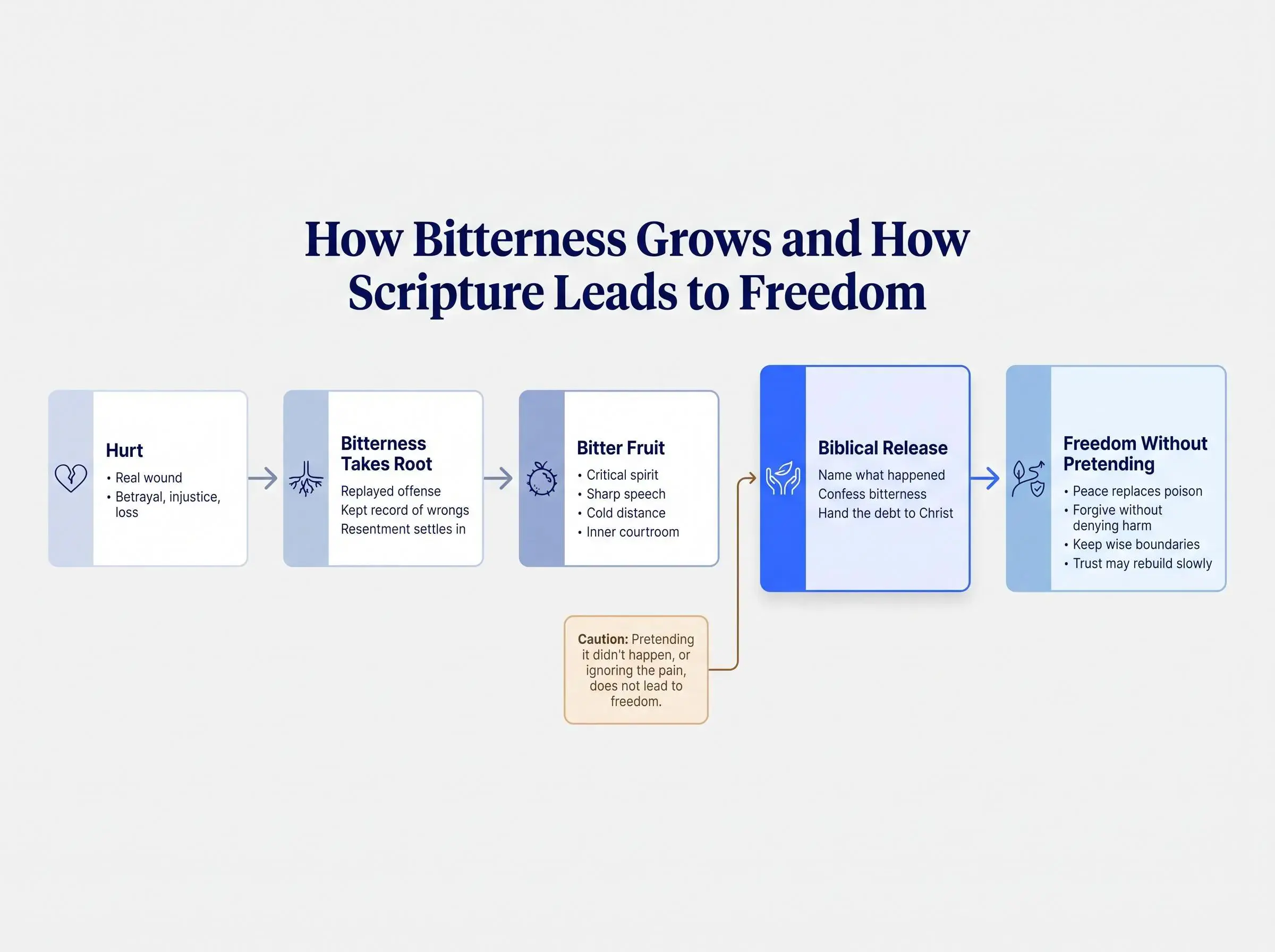
Healing gets clearer when it gets specific. Vague language protects bitterness. Honest naming exposes it.
Start here:
Biblical healing process
- Identify the injury
Identify the person, event, loss, or injustice.
- Name the cost
Admit what it cost you. Name the fear, humiliation, anger, betrayal, or stolen years.
- Separate injury from response
Separate the original injury from the sinful response that grew afterward.
- Confess the bondage
Confess bitterness as bondage, not wisdom.
- Release the debt
Bring the case to Jesus and release the debt specifically.
That fifth step is the center of forgiveness. Not a mood. A transfer. You stop demanding payment in your heart and place the case in Christ’s hands.
The feeling may not change in the first ten minutes. Sometimes forgiveness is decisive before it feels complete. When the memory comes back, you may need to reaffirm the release. But something real changes at surrender. You’re no longer defending the poison.
Then replace the inner rehearsal. Not with denial, but with truth. Prayer. Gratitude. Blessing instead of revenge scripts. And use boundaries where they are needed. Releasing bitterness does not mean returning to abuse, forcing trust, or pretending there is no danger.
If the wound is severe, long standing, or tangled with shame and family damage, don’t try to be heroic in isolation. Bring it into trusted Christian support.
For readers who need daily help applying this in real life, Terry Stueck’s Forgive Instantly & Live Free is a straightforward guide. It deals with anger, resentment, stress, hang-ups, and the practical act of release without dressing it up.
What Forgiveness Is and Is Not
Many wounded believers resist forgiveness because they misunderstand what forgiveness is and is not, thinking it means calling evil small. Scripture never asks for that.
Forgiveness is not:
- saying the wrong was acceptable
- denying facts
- removing consequences
- dropping all boundaries
- instant reconciliation
- emotional amnesia
Trust may need rebuilding. Some relationships may remain limited. Some should remain distant. And memory may stay, even after the debt has been released.
Forgiveness is the refusal to keep collecting payment in the heart. It is entrusting justice to God rather than appointing yourself final judge. It is compatible with truth telling, reporting harm, and protecting the vulnerable.
This is where some readers need relief and correction at the same time. You do not need to pretend. But you also do not get to make bitterness respectable because the wound was real.
How to Stay Free When the Hurt Returns

Old wounds come back around. Anniversaries do it. Fresh conflict does it. A phone call, a name, a photo, a casual comment. Suddenly the old case is back on the bench.
Deal with it early.
A simple pattern works better than dramatic self analysis:
- notice the trigger
- name the resentment
- release it to Christ again
- refuse the mental courtroom
Use Ephesians 4 and Hebrews 12 as diagnostics. Is bitterness showing up as wrath, anger, slander, malice, or trouble spreading to others? That question will tell you more than your self explanations will.
Don’t isolate. Bitterness grows in secrecy and weakens in the light. Stay honest with mature believers. Also watch the small reseeding sins: comparison, jealousy, criticism, self pity. They often reopen what you thought was settled.
This is where Kingdom language becomes practical. Life under Christ’s rule means surrendering personal vengeance. Citizens of His Kingdom don’t carry private courts in their chest.
What Research Suggests About Replaying Hurt
The Bible’s warning about returning to the same grievance has a measured parallel in psychology, though it does not replace the Bible’s teaching. In a self-report study of 580 college students in Wuhan, China, self-control had a moderate positive correlation with trait forgiveness ($r = 0.34$). The researchers’ model also found a small indirect pathway linking self-control to forgiveness through rumination and then anger ($\beta = 0.02$). In plain terms: repeated mental replay and anger appeared together as part of the path associated with a lower readiness to forgive.
That is not proof that every painful memory is bitterness, nor does it mean a person can simply will away anger. The study was observational, used one student sample, and cannot show that rumination causes unforgiveness. But it does give practical weight to the instruction to notice the trigger and refuse to keep rehearsing the case. When the hurt returns, bringing it honestly to Christ is different from feeding it in private.
Conclusion
Bitterness in the Bible is not a harmless coping habit. It is a corrosive root that damages the heart, the mouth, relationships, and your walk with God.
Scripture does not ask wounded people to deny their pain. It tells them to bring that pain into the light, let God name the poison, and stop carrying it as if it were protection. That’s a harder word than comfort at first. It is also kinder.
So take the next step plainly. Identify the wound. Confess the bitterness it produced. Release the debt to Jesus today instead of replaying it one more night.
Freedom often starts there, in one honest act of surrender, when the heart stops defending what Christ is ready to heal.
Pingback: What Causes Bitterness in the Heart? A Christian Guide