Scriptures about the Kingdom of God can get turned into a fog of charts, arguments, and religious language. But Jesus spoke about the Kingdom to people carrying fear, sickness, shame, debt, and hard habits. That matters.
As you read, don’t hunt for trivia. Watch for the response: repent, believe, seek, go, obey. The Kingdom is not distant doctrine for someday.
Let these verses bring you back under the King.
1. Matthew 3:2
This is where many people should start when studying the Kingdom. John the Baptist steps into the story and says, “Repent, for the kingdom of heaven is at hand.” That is not a lecture. It’s a summons.
If you’re building a kingdom of God Bible study guide, this verse keeps you honest. The Kingdom does not arrive first as a subject to analyze. It arrives as a call to turn.
Repentance here is not a passing feeling of guilt. It is a real return to God. Direction changes. Loyalties change. Habits don’t get to stay untouched. John is preparing people for the Messiah, and he does it by telling them they can’t keep drifting.
Matthew uses “kingdom of heaven” here, and in the Gospel record that often parallels “kingdom of God.” The point is not a different message. The point is that God’s rule has drawn near and people must respond.
That urgency matters. Near means now. Not after you clean yourself up. Not after you understand every doctrine. Many people in recovery or deep spiritual struggle make the same mistake. They try to collect insight before surrender. That order will stall you every time.
A good study question from Matthew 3:2 is simple:
- What has to change in me if God’s rule is actually near?
- Where am I calling regret repentance when nothing in my life is moving?
- What am I still defending that God’s rule would not permit?
This verse is the doorway. Later passages will add faith, mission, healing, and worldwide witness. But the first step is plain. Turn back.
Kingdom study begins with surrender, not note taking.
2. Matthew 4:17
Jesus takes up the same message after John. “Repent, for the kingdom of heaven is at hand.” That continuity matters more than people think.
John announces. Jesus continues and fulfills. The message did not get replaced when Christ appeared. It got confirmed and brought into sharper focus through Him.
This belongs on any list of scriptures about the kingdom of God because it shows what sat at the center of Jesus’ preaching from the start. Not later. Not occasionally. Right away.
Put Matthew 3:2 and Matthew 4:17 side by side and a pattern appears:
- John prepares people for the King’s arrival
- Jesus proclaims the Kingdom as the core of His own ministry
- both call for repentance because God’s rule is close, not remote
That corrects a common mistake. The Kingdom is not merely about going to heaven someday. Jesus says it has drawn near in connection with His ministry on earth. When He speaks of the Kingdom, He is calling people into a changed mind, a changed direction, and a changed allegiance.
We’d put it this way at High Plains Bible Mission: simple Christianity begins by obeying the plain words of Jesus. People often want a large system before they’ll act. Jesus starts with a command.
Read this verse and ask:
- What does repentance look like when Jesus is King?
- How is that different from keeping religious routines?
- Where has habit replaced obedience in my life?
Some verses stretch your mind. This one confronts your will.
3. Mark 1:14
Mark adds an important phrase. After John’s arrest, Jesus comes into Galilee “proclaiming the gospel of God.” Now the Kingdom message is named as good news.
That matters because many people hear “kingdom” and think only of demand, judgment, or distant prophecy. But here the message comes as good news from God. If you’ve asked, what is the gospel of the kingdom, Mark starts clearing the fog.
Notice where Jesus goes: Galilee. Ordinary towns. Public life. Pressure. This is not a message kept for scholars, rulers, or quiet religious spaces. It enters communities where people are trying to live, work, and endure.
And the timing is not tidy. John has been arrested. Loss and transition are already in the air. Jesus doesn’t pause Kingdom proclamation because the moment is unstable. He brings it right into instability. That should steady some of our readers. Plenty of people wake up to God when life is already shaking.
A few things stand out in this verse:
- the message comes from God, not from man’s invention
- it moves into real places, not abstract discussion
- it reaches people living under strain
If you’ve treated the Kingdom as a side study for later, Mark won’t let you do that. The good news of God shows up where people are already hurting.
The next verse tells you exactly what that good news says.
4. Mark 1:15
This is one of the clearest summary statements in the Gospels: “The time is fulfilled, and the kingdom of God is at hand; repent and believe in the gospel.” If you only had one verse for a starting map, this would be hard to beat.
Jesus joins time, Kingdom, repentance, and faith in one line. The time is fulfilled. Something long promised has arrived. The Kingdom is at hand. God’s saving reign has drawn near in Jesus. Repent and believe. The proper response is not observation. It is turning and trusting.
This advances beyond Matthew 3:2 and Matthew 4:17. Those verses stress repentance. Mark 1:15 adds belief in the gospel. That matters. Some people turn from obvious sin for a while and still never entrust themselves to Christ. Others say they believe but never turn. Jesus puts both together.
For readers battling anger, addiction, shame, or spiritual exhaustion, that is good news. God’s reign does not arrive as bare demand. It comes with gospel. The King comes near with mercy, authority, and a call to trust Him.
Study this verse slowly:
- What is fulfilled here?
- Why does Jesus join repentance and belief?
- Where have I tried to keep a passive Christianity that costs me nothing?
- Do I treat the Kingdom as close enough to obey, or far enough to postpone?
If you want help thinking through citizenship, allegiance, and life under the King, The Seeker’s Guide to the Kingdom of God is a useful next step. But don’t rush past the verse itself. Mark 1:15 will preach to you if you let it.
5. Matthew 4:23
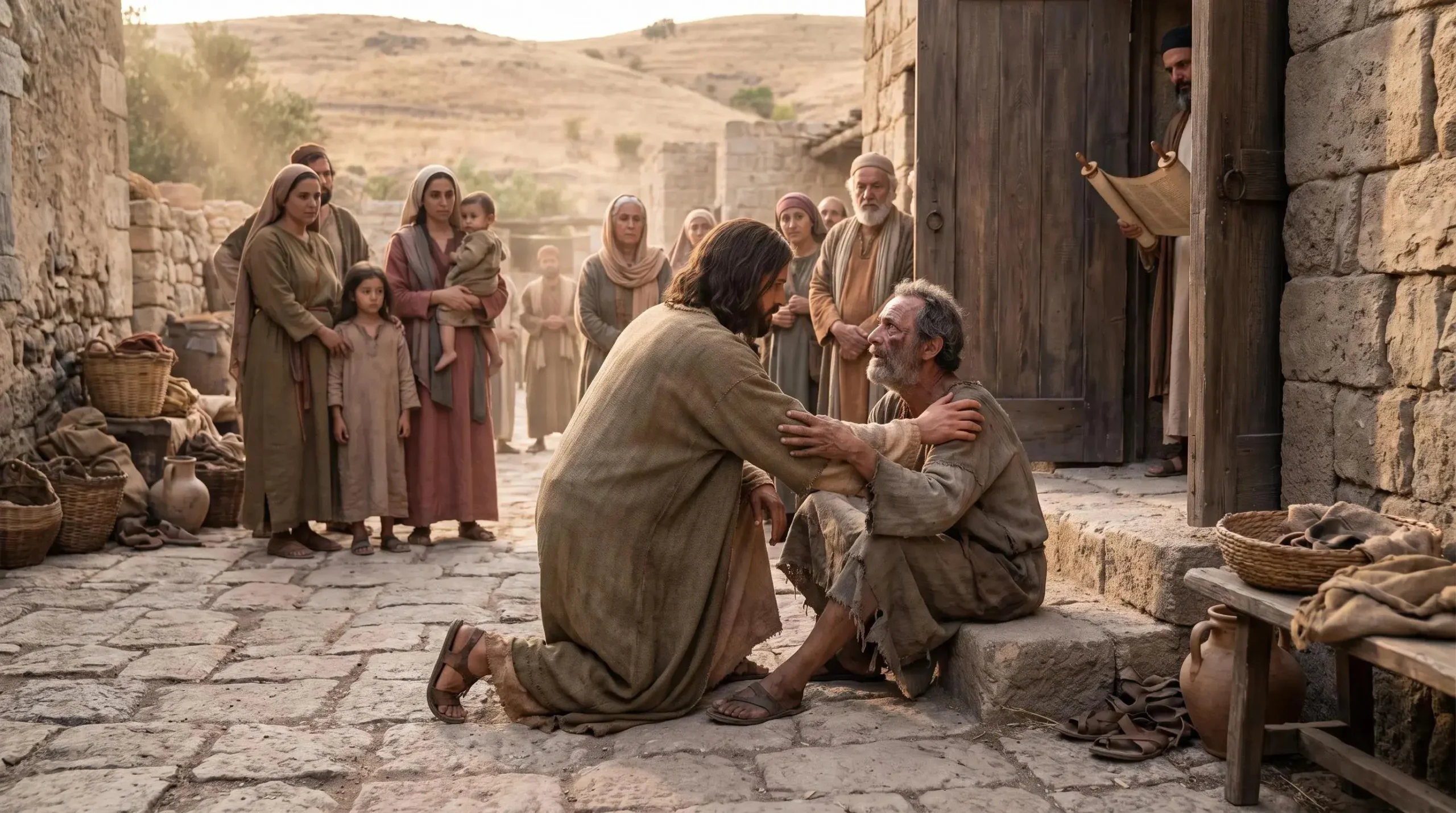
Here the message takes visible shape. Jesus goes throughout Galilee teaching in synagogues, preaching the gospel of the kingdom, and healing every disease and sickness among the people.
That threefold pattern matters. Jesus instructs. Jesus proclaims. Jesus heals. A kingdom of God Bible study guide that only tracks words and ignores mercy will miss the movement of the text.
Healing in this verse is not a side display. It shows the character of the Kingdom. Under God’s rule, affliction is confronted. Disorder is challenged. Suffering people are not pushed to the edge while theology stays in the center.
For the people we serve, this lands close to home. In prison work, recovery work, anger work, and spiritual restoration, pain is never theoretical. Neither is the Kingdom. If your idea of God’s reign has nothing to say to sickness, torment, or battered lives, it is too small.
Mark 1:15 states the message. Matthew 4:23 shows the message embodied in public ministry.
You can study this verse through its pattern:
What the gospel of the kingdom looks like
- teaching, because people need truth
- preaching, because truth must be announced
- healing, because God’s rule moves toward the afflicted
That is one reason The Kingdom in 1st Century Christianity matters to many readers. It helps connect the Kingdom Jesus preached with the lived character of early Christianity. Not polished theory. Life under a King.
6. Matthew 6:33
Jesus now brings the Kingdom into daily decisions: “Seek first the kingdom of God and his righteousness.” This is where a lot of Bible study either becomes real or stays decorative.
People ask how to study the kingdom of God, and often they mean, “How do I understand the terms?” Fair question. But Jesus presses harder. What comes first in your actual life?
This verse stands in a context of anxiety about food, clothing, and daily needs. So seeking the Kingdom first is not detached from ordinary pressure. It is spoken right into it. That helps people who feel pressed by bills, stress, family strain, cravings, or inner unrest. Kingdom study is not an escape from life. It reorders life.
Seeking God’s righteousness here is not about winning a theological debate. It is about coming under God’s will. Repentance begins the turn. Seeking first the Kingdom continues the path.
Try using questions that don’t let you hide:
- What gets first place in my schedule, spending, reactions, and attention?
- What competes with God’s rule in me?
- What would righteousness look like in a very ordinary Tuesday?
Sometimes anxiety and unforgiveness travel together. So do fear and control. In that sense, Forgive Instantly & Live Free can help readers who see that resentment keeps disturbing their peace under God’s rule. We have seen this often. A person can talk about the Kingdom and still be ruled by injury.
You are always seeking something. Jesus tells you what deserves first place.
7. Luke 4:43
Jesus says, “I must preach the good news of the kingdom of God to the other towns also, because for this purpose I was sent.” That word must carries weight.
This verse shows that Kingdom proclamation was central to why Jesus was sent. Not optional. Not occasional. Mission was built into His purpose.
There is also a hard edge here. Jesus refuses to stay where He is already welcomed if other towns still need the message. That cuts across comfort driven ministry. It also cuts across private religion. The Kingdom does not fold inward. It moves outward.
Luke makes explicit what Matthew 4:23 shows by pattern. Jesus goes from place to place because the good news of the kingdom of God belongs in more than one town, more than one circle, more than one safe room.
For us, this fits the streets, highways, and hedges instinct of ministry. The message belongs where hurting people actually live.
Questions worth asking from this verse:
- Why does Jesus say must?
- What are the “other towns” we ignore because they inconvenience us?
- Where has comfort made us disobedient?
If your Kingdom study never pushes you outward, something has gone wrong.
8. Matthew 9:35
Matthew repeats the pattern. Jesus goes through all the cities and villages, teaching, preaching the gospel of the kingdom, and healing every disease and sickness. Repetition in Scripture is not wasted space. It is often correction.
We tend to reduce Jesus’ ministry to the parts we prefer. Some like teaching but not mercy. Some like miracles but not repentance. Some like personal devotion but not mission. Matthew 9:35 will not let us split the whole.
The wider setting adds emotional force. Jesus sees people as sheep without a shepherd. That means Kingdom ministry is not cold efficiency. It is directed toward scattered, needy, confused people.
This matters in prison ministry, recovery ministry, and spiritual restoration. People often arrive disoriented, ashamed, angry, medicated by habits, and worn thin. The Kingdom is not embarrassed by that kind of need. Jesus moved toward it.
What this repeated pattern guards us from
- preaching a Kingdom that never touches human misery
- helping people physically while never naming the King
- treating one event as the whole model instead of the steady shape of Jesus’ work
The Gospel record keeps saying the same thing because we keep drifting from it.
9. Matthew 24:14

Now the horizon widens: “This gospel of the kingdom will be preached in the whole world as a testimony to all nations, and then the end will come.”
Jesus still calls it the gospel of the kingdom. That matters. The global mission is not a different message from the one preached in Galilee. It is the same message carried farther.
This answers a common question. Does Kingdom language fade after the Gospels? No. Jesus Himself projects its proclamation to all nations. The mission grows from other towns to the whole world.
There is also a testimony element here. The message bears witness. It confronts nations with the reality of God’s rule in Christ before the end comes. So studying scriptures about the kingdom of God should enlarge your vision. The Kingdom is not a private comfort system for your inner life. It concerns the nations.
Hold this verse next to Luke 4:43 and you can feel the expansion:
- other towns
- all the world
- all nations
Present obedience and future fulfillment belong together here. The Kingdom is near, active, and still moving toward full expression.
10. Luke 17:20–21
This passage helps answer one of the biggest questions in Kingdom study. Is the Kingdom present now, future, or both? Jesus says the kingdom of God is not coming in ways that can be observed as people expected, and that it is in their midst.
That corrects the idea that the Kingdom must first appear as an obvious political takeover or a spectacle everyone can chart from the outside. Jesus insists that God’s reign is already present in and through Him.
That does not cancel the future fullness of the Kingdom. Matthew 24:14 still points ahead. But Luke 17:20–21 keeps you from pushing the Kingdom so far into the future that you miss the King standing in front of you.
That is a hard mistake to make, but people make it all the time. They look for scale, noise, and visible takeover, and miss Christ.
Sit with these questions:
- Where do I expect the Kingdom to appear?
- Am I looking only for spectacle?
- How does Jesus’ presence change the whole subject?
For readers who feel spiritually disconnected, this passage can be a relief. The Kingdom is not merely a distant event to decode. God’s reign has come near in Jesus.
If you miss Jesus, you miss the Kingdom while talking about it.
What These 10 Scriptures Reveal About What the Kingdom of God Is
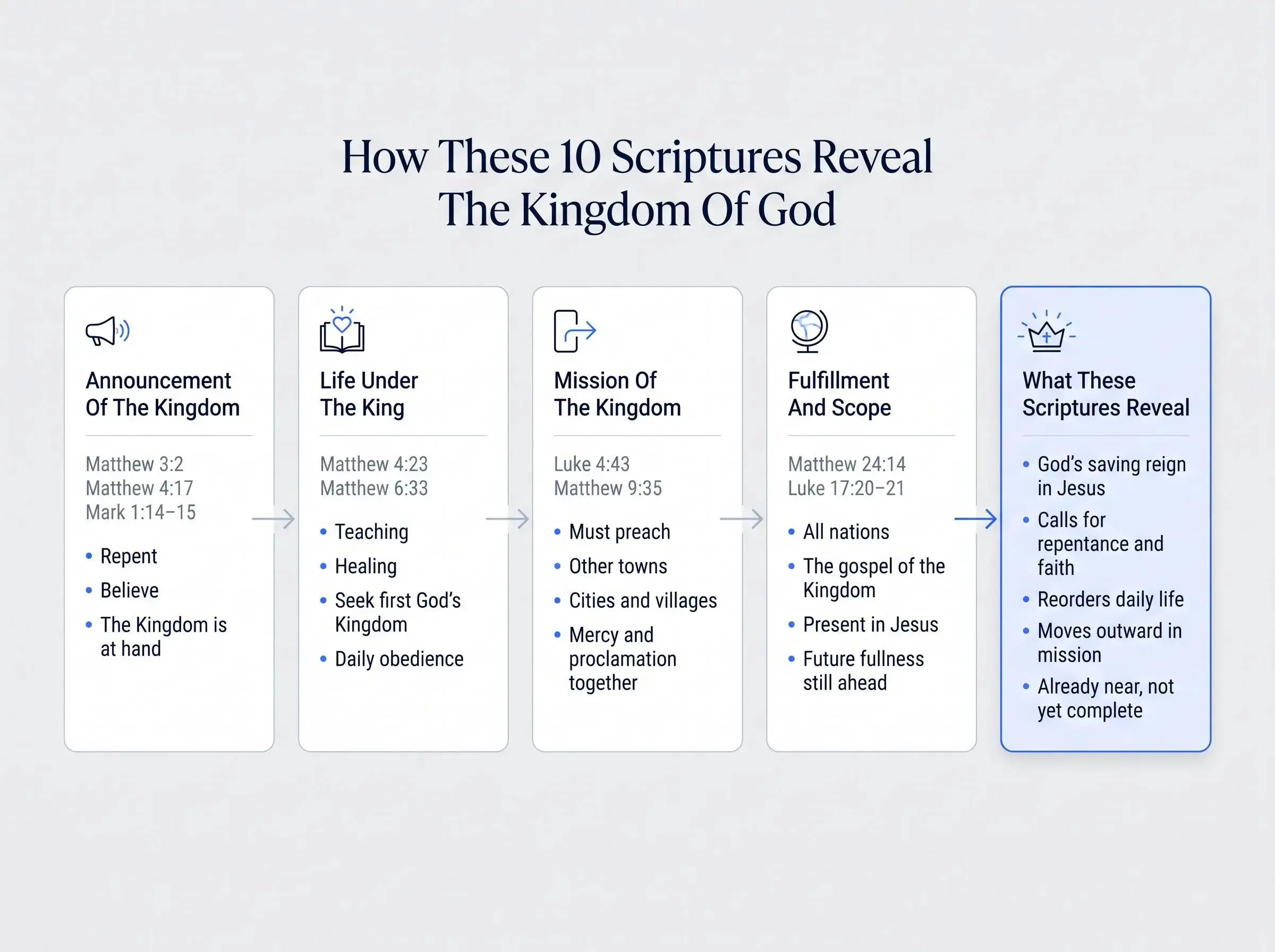
Taken together, these scriptures about the kingdom of God tell one coherent story. The Kingdom is God’s saving reign breaking into history through Jesus, calling for repentance, faith, obedience, proclamation, and hope.
Across these passages, the pattern is steady:
- repentance at the threshold
- faith in the gospel
- teaching and healing as signs of Kingdom life
- mission that keeps moving outward
- a present reality that still awaits full expression
They also help answer what is the gospel of the kingdom. It is the good news that God’s rule has drawn near in Jesus and must be received, obeyed, and proclaimed.
These texts also clear up common confusion. The Kingdom is not only heaven after death. It is not only inner feelings. It is not only future prophecy. And it has everything to do with suffering people now. Sick bodies, anxious minds, scattered crowds, neglected towns, and nations still needing witness all appear in these passages.
As for “kingdom of heaven” and “kingdom of God,” the Gospel writers use both expressions around the same core message. Don’t get lost chasing a difference the texts here are not pressing.
How to Study the Kingdom of God Without Getting Lost in Abstractions
Keep your study simple enough to obey. That is our counsel.
Use these ten passages as a working kingdom of God Bible study guide, and ask the same five questions in each one:
- What does this passage say about God’s rule?
- What response does it call for?
- What does it show about Jesus?
- What does it reveal about the gospel of the kingdom?
- How should this change life today?
It also helps to trace repeated words and movements. Watch for repent, believe, preach, seek, heal, towns, nations, and near. Scripture often teaches by repetition before it teaches by complexity.
You can group the verses like this:
- announcement of the Kingdom
- life under the Kingdom
- mission of the Kingdom
- fulfillment of the Kingdom
A few mistakes will throw you off fast:
- isolating one verse from the rest
- treating the Kingdom as only future
- treating it as only symbolic
- ignoring Jesus’ practical ministry to the afflicted
- studying without personal obedience
If you want to go deeper after working these core texts, The Kingdom in 1st Century Christianity and The Seeker’s Guide to the Kingdom of God are good next reads. But don’t use books to avoid the plain force of the passages. The goal is not to win arguments about the Kingdom. It is to come under the rule of the King.
Conclusion
These 10 scriptures about the kingdom of God do not give you scattered religious ideas. They give you a unified message. The Kingdom is near in Jesus, calls for repentance and faith, reshapes daily priorities, moves outward in mission, and will be proclaimed to all nations.
Study these passages slowly. Pray through them. Look for the places where God’s reign meets real fear, pain, habits, pressure, and decisions. That is where Kingdom study stops being distant doctrine.
If you need a place to start this week, begin with Mark 1:15 and Matthew 6:33. Then work through the rest as a personal study or with a small group. Let the words of Jesus become lived reality, not material you merely recognize.